
Where the Ancient Forest Meets the Last Gorillas

"To enter Bwindi is to step into a world older than humanity itself — a world where the great apes still reign, and where the forest holds its mysteries close."

Introduction

There are places on earth that earn their names honestly, and Bwindi Impenetrable National Park is one of them. The word bwindi means "place of darkness" in the local Rukiga language — a reference to the dense, tangled canopy that filters the equatorial sun into a dim, green, cathedral light. Tucked into the remote southwestern corner of Uganda, on the edge of the Albertine Rift Valley where Uganda meets the Democratic Republic of Congo, Bwindi is one of the most ancient and ecologically significant forests in Africa. It has survived ice ages, climate shifts, and the destruction of most of the surrounding forest cover to remain, today, an irreplaceable sanctuary — and the best place on earth to encounter the mountain gorilla in the wild.

Designated a UNESCO World Heritage Site in 1994, Bwindi covers 321 square kilometres of steep, mist-draped terrain at altitudes ranging from 1,160 to 2,607 metres above sea level. Its age — estimated at over 25,000 years — and its isolation have made it a crucible of biodiversity. Over 1,000 plant species, 360 bird species, and more than 120 mammal species have been recorded here, many of them found nowhere else in the world.

The Gorillas of Bwindi

Bwindi is home to roughly half the world's total population of mountain gorillas — a species so endangered, so charismatic, and so deeply connected to our own evolutionary history that an encounter with one is capable of moving grown travellers to tears. The park currently protects over 450 individual gorillas distributed across multiple family groups, of which more than 20 have been habituated to human presence for tourism or research purposes.

Gorilla trekking begins at one of four entry points — Buhoma in the north, Ruhija in the east, Rushaga in the south, and Nkuringo in the southwest — each offering access to different habituated groups and different terrain. Groups of eight visitors per family per day are led by Uganda Wildlife Authority rangers and expert trackers into the forest at dawn. The trackers, many of them from communities that have lived alongside the forest for generations, read the landscape with extraordinary skill — bent stems, knuckle-drag marks, half-eaten vegetation, fresh dung — following a trail that may lead one kilometre into the forest or five.

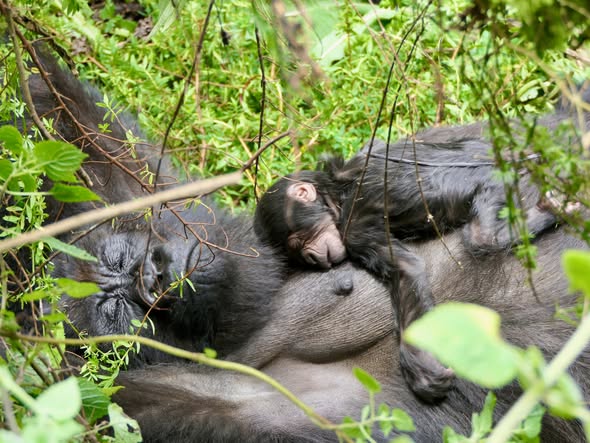
When contact is made, the hour that follows is unlike any other wildlife experience. A silverback — a mature male who may weigh 220 kilograms or more — sits in the undergrowth with the settled, unhurried authority of an animal that fears nothing. Females nurse infants with a tenderness that is immediately recognisable. Juveniles tumble over each other in play. Occasionally, a gorilla will walk directly past a visitor, so close that eye contact is inevitable — and it is in those moments that the awareness of shared ancestry, separated by only 98.7% of identical DNA, becomes almost overwhelming.

Permits are priced at USD 700 per person and must be booked well in advance, particularly during the peak season of June to September and December to February.

Beyond the Gorillas

Bwindi is far more than a gorilla sanctuary. The forest supports chimpanzees, l'Hoest's monkeys, black-and-white colobus, olive baboons, and several other primate species. Its bird list is exceptional, with 23 Albertine Rift endemics including the African green broadbill, Shelley's crimsonwing, and the stunning Grauer's rush warbler. Forest walks led by guides explore the ecology of the ancient trees — some of them hundreds of years old — the medicinal plants used by local healers, and the insects, amphibians, and reptiles that fill every ecological niche.

The communities surrounding Bwindi are deeply woven into the park's story. The Batwa — forest-dwelling hunter-gatherers who lived inside Bwindi for thousands of years before the park's establishment — offer cultural experiences that are both moving and enlightening, sharing their deep knowledge of forest plants, traditional practices, and the history of their extraordinary relationship with the forest.

Getting There & Practicalities

Bwindi is approximately eight to nine hours by road from Kampala, or accessible via charter flight to Kihihi or Kisoro airstrips. Accommodation ranges from luxury lodges with stunning valley views — several perched literally on the forest edge — to mid-range bandas and budget guesthouses in the surrounding villages. The best time to trek is during the dry seasons (December to February and June to September), though the forest can be visited year-round.